A Journey Beyond the Roll: 7 Japanese Dishes That Deserve a Place at Every American Table

Photo: Rudd, Margaret Caroline, Public domain, via Wikimedia Commons
Ask most Americans to name a Japanese dish and the answer will almost certainly involve raw fish, vinegared rice, or some combination of the two. Sushi has been an extraordinary ambassador — it opened doors, sparked curiosity, and built an industry. But in doing so, it also cast a long shadow over the extraordinary breadth and depth of Japanese culinary culture.
Japan is a country of dramatic regional diversity, with distinct food traditions shaped by local geography, climate, and history. The ramen of Sapporo tastes nothing like the ramen of Fukuoka. The street food of Osaka bears little resemblance to the refined kaiseki of Kyoto. This richness is precisely what makes Japanese cuisine one of the most rewarding in the world for adventurous diners — and precisely what tends to get lost when the conversation begins and ends with the sushi menu.
At Daikoku Ginza, we believe that authentic Japanese dining is an invitation to explore. Here are seven dishes that represent the true scope of Japan's culinary heritage — each one worth seeking out, savoring, and understanding.
1. Tonkotsu Ramen — Fukuoka, Kyushu
If there is a single dish capable of converting a skeptic into a devotee in a single bowl, it may well be tonkotsu ramen. Originating in the street stalls of Hakata (the commercial district of Fukuoka City on the southern island of Kyushu), tonkotsu is defined by its broth — a rich, opaque, ivory-colored liquid produced by boiling pork bones at a vigorous simmer for many hours until the collagen, marrow, and fat emulsify into something extraordinarily complex.
The result is a broth that is simultaneously light and deeply savory, with a silky body that coats the palate. Served with thin, straight noodles, sliced chashu pork belly, a soft-boiled marinated egg, and sheets of nori, a proper bowl of tonkotsu ramen is one of the most satisfying eating experiences in any culinary tradition. For American diners accustomed to the heartiness of a great bowl of soup, this is familiar comfort taken to an entirely different level.
2. Okonomiyaki — Osaka and Hiroshima
The name translates roughly as "grilled as you like it," and the dish lives up to that liberating description. Okonomiyaki is a savory pancake built on a batter of flour, grated nagaimo (Japanese mountain yam), dashi, and shredded cabbage, then layered with proteins of your choosing — shrimp, pork belly, squid, or cheese — and cooked on a flat iron griddle.
What arrives at the table is finished with a drizzle of okonomiyaki sauce (a thick, sweet-savory condiment), Japanese mayonnaise, dried bonito flakes that dance in the heat, and a dusting of aonori (dried green seaweed). Osaka and Hiroshima each claim distinct versions of the dish, with Hiroshima's layered style incorporating noodles. Either way, okonomiyaki is the kind of food that makes you wonder why it isn't on every American brunch menu.
3. Shabu-Shabu — Osaka Origins, National Icon
Shabu-shabu is Japanese hot pot at its most elegant — a dining experience as much as a meal. Paper-thin slices of premium beef (wagyu, when the occasion calls for it) are swished briefly through a pot of gently simmering kombu dashi at the center of the table, cooked in seconds, and dipped into either ponzu (a citrus-soy sauce) or a creamy sesame sauce before eating.
The communal, participatory nature of shabu-shabu makes it ideal for groups, and the cooking process itself is meditative — an exercise in attention and timing. For American diners who enjoy the social dimension of Korean barbecue or fondue, shabu-shabu offers a similarly engaging format with a distinctly Japanese sensibility: lighter, more refined, and centered on the quality of the primary ingredient rather than bold seasoning.
4. Kaiseki Ryori — Kyoto
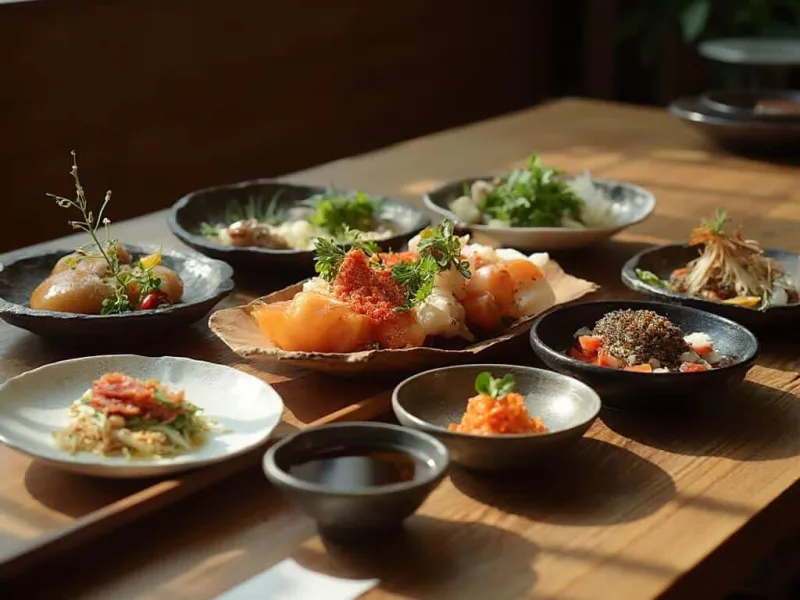
If washoku is a philosophy, kaiseki is its highest expression. Rooted in the tea ceremony culture of Kyoto, kaiseki is a multi-course tasting experience in which each dish is designed to reflect the season, honor the guest, and demonstrate the chef's mastery of restraint. A kaiseki meal might include a delicate appetizer of seasonal vegetables in a light broth, a grilled fish course, a simmered dish, a rice course, and a refined dessert — each presented on carefully chosen ceramics that complement the food's colors and textures.
Kaiseki is not everyday dining. It is an occasion, a statement, and — for those who approach it with the right mindset — a genuinely moving experience. In the United States, a growing number of establishments are offering kaiseki-inspired tasting menus that bring this tradition to American audiences without compromising its integrity.
5. Yakitori — Tokyo and Beyond
Yakitori — grilled chicken skewers prepared over a binchotan charcoal fire — is one of Japan's most beloved and democratic foods. Found everywhere from the alley-side stalls of Tokyo's Yurakucho district to high-end specialty restaurants, yakitori celebrates the entire bird: not just breast and thigh, but liver, heart, skin, cartilage, and the prized oyster cut. Each part is seasoned with either tare (a sweet soy-based glaze built up over years of use) or simply salt, and grilled to precise doneness.
For American diners, yakitori is often a revelation — proof that chicken, treated with care and cooked over real fire, can be genuinely extraordinary. It is also an excellent entry point for those curious about Japanese izakaya culture, the convivial pub-style dining tradition that pairs small plates with cold beer and sake.
6. Chawanmushi — Nationwide
Chawanmushi is Japanese savory egg custard, steamed in a small ceramic cup until it achieves a texture so delicate it trembles at the slightest touch. The custard base is a mixture of eggs and dashi, poured over a small arrangement of ingredients — typically a piece of shrimp, chicken, ginkgo nut, and mitsuba herb — that are revealed as the spoon descends through the silken surface.
It is a dish that rewards slow eating and quiet attention. The flavor is subtle — umami-forward, barely seasoned, yet deeply satisfying. In a dining culture that often equates impact with volume, chawanmushi is a gentle reminder that the most profound pleasures at the table are frequently the quietest ones.
7. Kakiage — Coastal Japan
Tempura is well known in America, but its lesser-celebrated cousin, kakiage, deserves equal recognition. Where tempura typically features individual ingredients in a light batter, kakiage combines a mixture of finely cut vegetables and seafood — burdock root, carrot, onion, small shrimp — into a single fritter that is fried until crisp on the outside and yielding within. Served over a bowl of hot rice or atop a bowl of udon noodles with a light dipping broth, kakiage is Japanese comfort food in its most honest and satisfying form.
The technique requires precision — the batter must be cold, the oil must be hot, and the timing must be exact — but the result is a dish that demonstrates the extraordinary potential of simple ingredients treated with skill and respect.
The seven dishes described here represent only a fraction of what authentic Japanese cuisine has to offer. Each one carries the history, geography, and culinary intelligence of the culture that created it. At Daikoku Ginza, we are committed to bringing these traditions to the American table — not as novelties or approximations, but as genuine expressions of a culinary heritage that has spent centuries perfecting the art of nourishment.
The next time you sit down to explore Japanese cuisine, we encourage you to venture past the familiar and into the extraordinary. There is a great deal waiting for you beyond the roll.