Eight Seats, One Chef, No Walls: How the Ginza Counter Is Quietly Transforming American Fine Dining
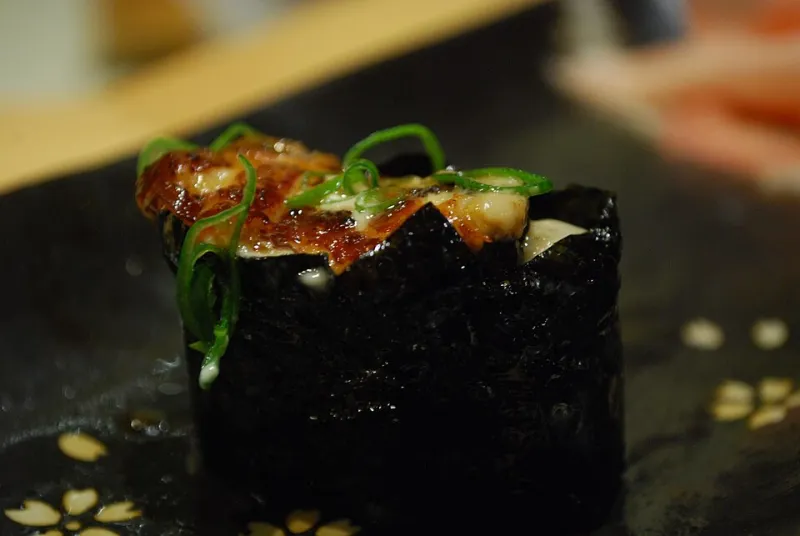
Photo: Alpha from Melbourne, Australia, CC BY-SA 2.0, via Wikimedia Commons
There is a particular moment that regular visitors to Ginza's finest counter restaurants describe with unusual consistency. You are seated — one of perhaps eight guests — at a smooth hinoki cypress bar. The chef stands no more than three feet away, his knife moving with quiet authority. There is no sommelier hovering, no expediter calling tickets, no architectural grandeur competing for your attention. There is only the food, the craftsman who made it, and an exchange so direct it borders on the personal.
This is the kappo and omakase model at its most refined, and it has spent decades earning Michelin stars in Tokyo. Now it is arriving in American cities with a confidence that is beginning to unsettle the established hierarchy of fine dining.
What Ginza Understood That the Grand Dining Room Did Not
For most of the twentieth century, American fine dining organized itself around spectacle. The room had to be vast enough to signal importance. The staff-to-diner ratio had to suggest abundance. The menu had to be long enough to demonstrate range. These conventions borrowed heavily from French haute cuisine, which was itself rooted in the aristocratic households of pre-revolutionary Europe.
Ginza's counter restaurants evolved from an entirely different set of values. Space in central Tokyo has always been scarce and expensive, which encouraged chefs to build inward rather than outward — to deepen the quality of each individual experience rather than widen the dining room. The result was an architecture of intimacy that turned a practical constraint into a philosophical statement.
A Ginza kappo chef does not manage a dining room. He manages a conversation. Each course arrives as part of an unspoken dialogue between what the chef has sourced that morning and what the guest communicates through their reactions, their pace, their silence. The menu is not a catalog of options; it is a single, unfolding narrative.
The Omakase Moment in American Cities
American diners first encountered omakase — the Japanese phrase meaning, roughly, "I leave it to you" — through high-end sushi bars in cities like New York and Los Angeles. For years, it existed as a premium tier within Japanese restaurants, a signal that a guest trusted the chef enough to surrender the menu entirely.
What is happening now is something more fundamental. Chefs trained in the Ginza tradition, or deeply influenced by it, are opening standalone counter restaurants that owe nothing to the conventional American fine dining blueprint. They are not Japanese restaurants with an omakase option. They are counter restaurants, full stop — designed from the ground up around the chef-diner relationship.
In New York, establishments such as Shion 69 Leonard Street have demonstrated that a ten-seat sushi counter can operate at the very summit of the city's culinary conversation, earning the kind of critical attention once reserved for multi-room temples of French technique. In Chicago, the model has taken root in the form of intimate Japanese-inflected tasting menus where the chef plates every dish directly in front of the guest. San Francisco, with its deep historical ties to Japanese culinary culture, has produced a generation of counter-format restaurants that regularly appear on national best-of lists.
The numbers are striking. A 2023 survey of Michelin-starred restaurants in New York found that counter-format Japanese restaurants accounted for a disproportionate share of three-star designations relative to their total count. The inspectors, it seems, have noticed what the guests already knew.
The Three Disciplines That Make It Work
Observing the counter restaurant model closely reveals three disciplines that American adopters must master if they hope to replicate its impact.
Hyper-focused sourcing. A Ginza chef running eight seats does not need a broad supply chain. He needs the finest possible version of a very small number of ingredients, sourced with obsessive consistency. American counter restaurants that succeed in this model — places like Odo in New York or Sushi Noz — share an almost monastic commitment to ingredient provenance. The fish comes from specific boats. The rice comes from a single farm. This is not marketing language; it is operational reality.
Minimalist plating as communication. In a large dining room, a plate must announce itself from a distance. At a counter, the guest is close enough to see a single drop of citrus oil catching the light. Ginza-trained chefs understand that restraint at this distance is not minimalism for its own sake — it is a form of respect for the ingredient. American chefs adopting this discipline often describe it as the most difficult adjustment, because it requires unlearning the instinct to demonstrate technique visibly.
The choreography of conversation. Perhaps the most underestimated element of the counter restaurant is the social intelligence it demands of the chef. He must read the room — all eight seats of it — simultaneously, calibrating pace, adjusting portions, knowing when to speak and when to allow a dish to communicate without commentary. This is a skill distinct from cooking, and the Ginza model treats it as equally important.
What American Diners Are Gaining — and Surrendering
The counter restaurant asks something of its guests that the conventional fine dining room does not: presence. There is no retreating into a private conversation at a corner table when the chef is standing three feet away, visibly invested in your experience of each course. Some American diners find this exposure energizing. Others find it uncomfortable, at least at first.
What guests consistently report gaining is a sense of connection to the food that is simply unavailable in larger formats. When you watch a chef slice a piece of aged bluefin with a single, unhurried stroke and place it before you without a word, you understand something about that fish — and about the person who prepared it — that no menu description could convey.
The surrender, of course, is control. Omakase is a trust exercise. You are not choosing; you are being chosen for. For a dining culture that has historically prized the power of selection — the thick menu, the wine list the size of a small novel — this represents a genuine shift in the social contract of a restaurant meal.
A Model With Room to Grow
The counter restaurant will not replace the grand American dining room. The appetite for celebration in expansive, theatrical spaces is too deeply embedded in the culture. But the Ginza model is carving out a permanent and increasingly prestigious place in the American culinary landscape, one that is likely to grow as a new generation of diners prioritizes depth of experience over breadth of choice.
For those who have not yet sat at one of these counters, the invitation is a simple one. Leave the menu behind. Trust the chef. Pay attention. What arrives over the next two hours may well redefine what you thought a restaurant could be.