Designing for the Senses: What Ginza's Legendary Dining Rooms Teach Us About Atmosphere and Authenticity

Photo: http://www.geographicus.com/mm5/cartographers/cruttwell.txt, Public domain, via Wikimedia Commons
There is a particular quality of stillness that greets you upon entering a great Ginza restaurant. It is not silence exactly — the soft percussion of a knife against a hinoki cutting board, the almost imperceptible sound of a sliding shoji screen, the measured pour of tea — but rather a carefully orchestrated calm. Everything in the room has been considered. Nothing has been left to chance.
Ginza, Tokyo's most luminous and historically significant commercial district, has produced some of the world's most admired dining establishments. The restaurants that carry the Ginza name do not merely serve food; they construct an experience governed by centuries of aesthetic philosophy. At Daikoku Ginza, this legacy is both an inspiration and a responsibility — a reminder that authentic Japanese dining is as much about environment as it is about what arrives on the plate.
The Weight of Ma: Space as Ingredient
Central to Ginza's design sensibility is the Japanese concept of ma — a term that translates roughly as "negative space" or "meaningful pause." In architecture and interior design, ma manifests as the deliberate absence of clutter, the breathing room between objects, the silence between notes in a musical phrase.
In practical terms, this means that a Ginza dining room rarely feels crowded, even when fully occupied. Tables are positioned to allow guests a sense of private enclosure without physical isolation. Sightlines are managed with the same care a landscape architect might give to a garden path — guiding the eye gently rather than directing it forcefully.
For American diners accustomed to the energy of a busy urban restaurant, this spatial restraint can feel almost disorienting at first. Then, gradually, it begins to feel like relief.
Light as Narrative
Few design elements distinguish an authentic Japanese dining environment more immediately than its approach to lighting. Where many Western restaurants default to ambient brightness or theatrical spotlighting, Ginza's finest establishments use light the way a painter uses shadow — to reveal, to suggest, and to create depth.
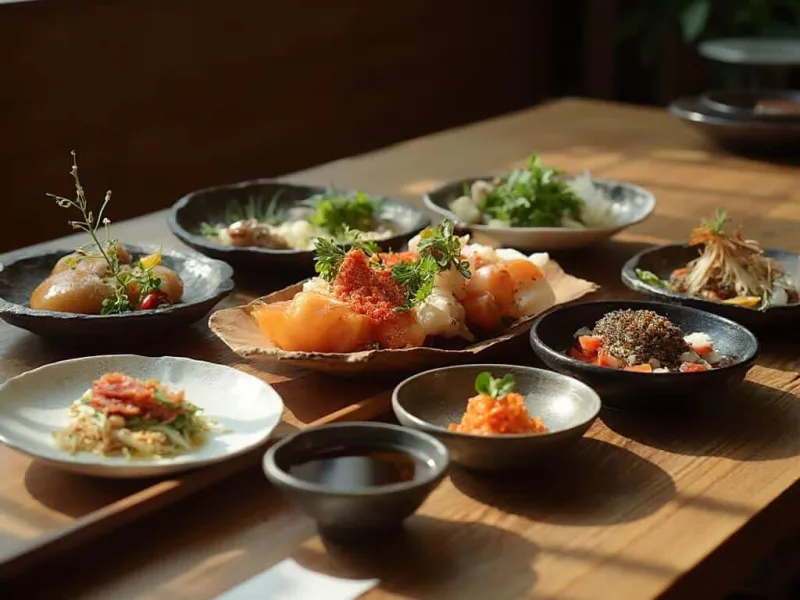
Warm, low-intensity illumination is the standard. Paper lanterns, recessed fixtures with warm-spectrum bulbs, and the occasional candle work in concert to produce a light quality that flatters both the food and the faces of those eating it. Dishes presented under this kind of light appear more vivid, their colors more saturated, their textures more pronounced.
This is not incidental. Japanese culinary tradition holds that the visual presentation of food — moritsuke — is as integral to the dining experience as flavor. Lighting is the final layer of that presentation, and Ginza's designers have understood this for generations.
Natural Materials and the Philosophy of Wabi-Sabi
The surfaces of a Ginza dining room tell their own stories. Unfinished wood, rough-hewn stone, handmade ceramics with visible irregularities, linen that carries the texture of its weave — these materials are chosen not despite their imperfections but because of them. This is wabi-sabi in practice: the Japanese aesthetic that finds beauty in transience, asymmetry, and the honest marks of natural process.
Hinoki cypress — prized for its pale color, its fine grain, and its faint citrus fragrance — appears frequently in countertops, serving boards, and architectural millwork. Its presence in a dining room is almost olfactory as much as visual, contributing a subtle warmth that synthetic materials cannot replicate. Similarly, yakisugi — charred cedar treated through an ancient Japanese preservation technique — appears on exterior facades and accent walls, its darkened surface carrying both visual drama and historical resonance.
In American restaurant design, the impulse is often to simulate these qualities through manufactured finishes. The Ginza standard insists on the authentic material, understanding that authenticity is perceived even when it cannot be consciously identified.
Seasonal Décor and the Discipline of Kisetsukan
One of the most distinctive and least imitated aspects of traditional Japanese restaurant design is its responsiveness to season. The Japanese concept of kisetsukan — seasonal awareness — demands that the dining environment reflect the time of year with the same attentiveness given to the menu.
In spring, a Ginza establishment might introduce cherry blossom branches in a simple ceramic vase near the entrance. Summer brings cooler textiles — linen napkins in pale blues and greens, bamboo accents, the visual suggestion of water and open air. Autumn calls for warm ochres and the placement of a single persimmon branch as a centerpiece. Winter demands restraint and warmth simultaneously: dark lacquered surfaces, candlelight, the comfort of heavy stoneware.
These seasonal gestures are not decorative afterthoughts. They are a form of hospitality — a signal to the guest that the establishment is paying attention, that the experience has been prepared specifically for this moment in time.
The Human Scale: Service Choreography and Spatial Flow
Authentic Japanese dining design is ultimately inseparable from the choreography of service. The physical layout of a Ginza restaurant is engineered around the movement of its staff — the angles of approach to a table, the width of aisles that allow a server to bow without obstruction, the placement of the kitchen pass to minimize disruption to the dining room's atmosphere.
This spatial intelligence is visible in the positioning of the counter — a defining feature of many Japanese dining formats, from sushi bars to kaiseki counter seats. The counter creates a relationship between chef and diner that is intimate without being informal, transparent without being theatrical. Guests observe the craft; the chef acknowledges the audience. It is a form of communication that requires no words.
What Ginza Teaches American Restaurants
The principles that define Ginza's dining environments are not culturally exclusive. They are, at their core, expressions of respect — for the guest, for the food, for the occasion of gathering at a table. American diners are increasingly receptive to these values, drawn to dining experiences that offer something more considered than efficiency and noise.
At Daikoku Ginza, we hold these principles not as museum pieces but as living design commitments. The stillness, the natural materials, the careful light, the seasonal sensitivity — these are not aesthetic choices made for their own sake. They are the architecture of a complete experience, one that begins the moment a guest steps through the door and lingers long after the final course has been cleared.