The Discipline of Less: How Japanese Minimalist Plating Exposes the Limits of American Fine Dining
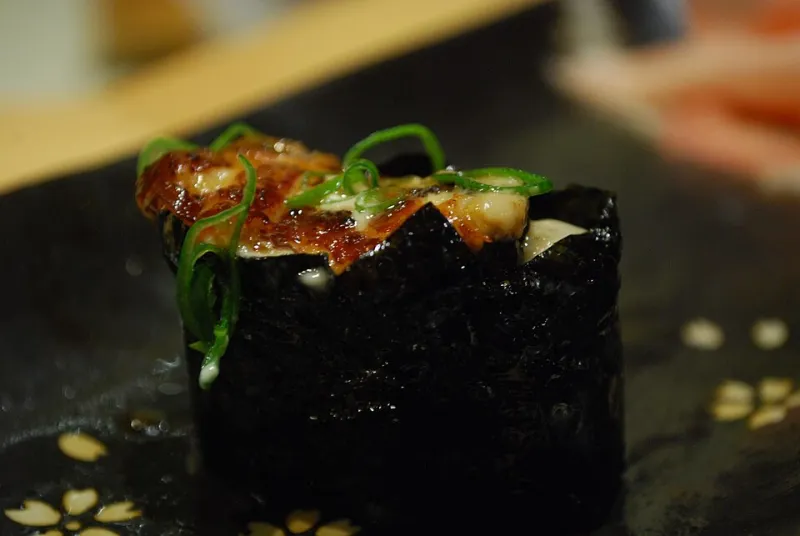
Photo: Nadiredg, CC0, via Wikimedia Commons
Consider two plates. The first arrives bearing a composed tower of protein, three architectural components, two sauces applied with precision tools, a scattering of microgreens, and a dusting of something that catches the light. The second holds a single piece of grilled fish, placed slightly off-center on a matte ceramic vessel, accompanied by a small mound of seasoned rice and a sprig of something green — nothing more. Which plate required greater skill to produce?
For most American diners, the instinctive answer would be the first. American fine dining culture has, for decades, operated under an implicit assumption that complexity signals effort, and that effort signals value. The more a plate contains, the reasoning goes, the more the kitchen has demonstrated its capability. It is an understandable logic, and not an entirely wrong one. But it is incomplete. And Japanese culinary tradition, increasingly visible in American dining rooms from New York's West Village to Los Angeles's Arts District, offers a compelling case for why.
What Negative Space Actually Does
In Japanese visual aesthetics, the concept of ma — often translated as negative space, though the term encompasses far more — is not the absence of something. It is a presence in its own right. Ma is the pause between notes that gives music its rhythm, the silence in a conversation that allows meaning to settle. On a plate, it is the uncovered ceramic that frames an ingredient rather than surrounding it with competing elements.
When a Japanese chef leaves substantial space on a vessel, that choice is deliberate and communicative. The empty area directs the diner's gaze toward what has been placed, elevating a single ingredient to a status it could never achieve if crowded by companions. The fish, the sliced vegetable, the precisely formed rice — each is given room to be seen fully, evaluated honestly, and tasted without the interference of adjacent flavors competing for attention.
This is, paradoxically, a more demanding form of presentation than maximalist plating. A tower of components can conceal a multitude of imperfections behind its complexity. An ingredient placed alone on a wide ceramic surface conceals nothing. The quality of the fish, the precision of the cut, the accuracy of the seasoning — all of it is exposed without apology. There is nowhere to hide.
Asymmetry as Intention
American plating convention, shaped in part by classical French technique, tends toward symmetry and centeredness. The protein occupies the center of the plate. Accompaniments are arranged around it with a certain bilateral logic. The composition is balanced in a way that feels resolved, complete, and — to a trained eye — somewhat predictable.
Japanese plating, by contrast, draws on the aesthetic principle of fukinsei — deliberate asymmetry. A component placed to the left of center creates visual tension. A vessel chosen for its irregular, handmade quality reinforces the sense that the arrangement has been considered rather than defaulted to. The diner's eye is not guided to a predetermined focal point; it is invited to move, to discover, to engage.
This is not asymmetry for its own sake. It reflects a broader Japanese philosophical orientation toward the beauty of imperfection and incompleteness — a concept known as wabi-sabi — which holds that a thing fully resolved and symmetrically perfect is, in a sense, finished and therefore inert. Something slightly off-balance retains energy. It suggests process rather than conclusion.
For American diners accustomed to plates that announce their own resolution, this can initially feel unsatisfying. The presentation does not perform its own appreciation. It requires the diner to bring something to the table.
The Conversation Between Chef and Vessel
One of the most visible expressions of Japanese minimalist plating philosophy is the relationship between food and tableware. In many American restaurants — even excellent ones — plates are largely interchangeable white or off-white backgrounds. The food is the art; the vessel is the canvas, and canvases do not call attention to themselves.
In Japanese dining culture, this relationship is entirely reconsidered. The vessel is chosen as carefully as the ingredient it will hold. A rough-glazed Shigaraki ceramic carries different meaning than a smooth lacquered bowl. The color, weight, texture, and shape of the tableware participate in the communication of the dish. A deep, dark plate against which a pale slice of fish appears luminous is not an accident of inventory. It is a compositional decision.
Chefs working in the Japanese tradition — whether in Tokyo or in American cities where this aesthetic has taken root — spend considerable time and resources acquiring tableware that extends their culinary vocabulary. The plate is not a neutral surface. It is part of the sentence.
What This Demands of the American Diner
Here is the honest challenge that Japanese minimalist plating presents to American diners: it asks for a different kind of engagement. The maximalist plate is, in a sense, generous. It offers entertainment, complexity, and the satisfaction of abundance. It does much of the interpretive work on the diner's behalf.
The minimalist plate offers something harder to receive: focus. It asks the diner to slow down, to notice, to evaluate what is present without the distraction of what surrounds it. It asks for a certain willingness to sit with simplicity long enough to discover that simplicity is not the same as emptiness.
This is a form of culinary literacy, and it is one that American dining culture is, gradually, developing. The growth of omakase dining in American cities — intimate, chef-directed experiences in which a sequence of small, precisely prepared courses unfolds without a menu — has introduced a significant number of American diners to this mode of attention. The format almost enforces the necessary posture: unhurried, receptive, present.
Restraint as the Highest Form of Confidence
At Daikoku Ginza, the philosophy we have always admired in Japanese culinary tradition is one that requires tremendous confidence to execute. It is far easier to add than to withhold. It is far easier to impress through accumulation than to trust that a single, perfectly prepared element speaks for itself.
The American dining landscape is richer for the increasing presence of this philosophy. Not because maximalism is wrong — there are contexts in which abundance and exuberance are exactly right — but because minimalism offers a corrective lens. It reminds us that restraint is not poverty. It is precision. And precision, in the end, is the most honest expression of skill a kitchen can offer.