Before the Bill, a Bowl of Rice: Why American Kitchens Are Rethinking How a Meal Ends
Ask most American diners to describe the end of a memorable meal, and the answers tend toward spectacle: a molten chocolate dome cracked open tableside, a liquid-nitrogen cloud drifting across the table, a dessert wine poured with theatrical flourish. The finale, in the American imagination, is the last chance to impress.
Japanese cuisine operates on an entirely different premise. In the kaiseki tradition — the multi-course formal dining style that evolved alongside the tea ceremony — the closing moments of a meal are treated not as a final flourish but as a settling. The meal does not crescendo. It exhales.
Shokuji: When the Meal Becomes Simple Again
Toward the end of a traditional kaiseki service, the kitchen offers what is known as shokuji: a modest bowl of steamed rice, a serving of pickled vegetables (tsukemono), and a clear or miso soup. After courses of elaborate technique — sashimi arranged like a garden, grilled fish glazed to a lacquered sheen — the food suddenly becomes plain. Deliberately so.
The logic is both practical and philosophical. Rice is the foundation of the Japanese table, the constant against which every other dish is measured. Returning to it at the meal's end brings the palate home. The pickles perform a gentle reset, their acidity cleansing the mouth after hours of accumulation. Nothing here is designed to astonish. It is designed to complete.
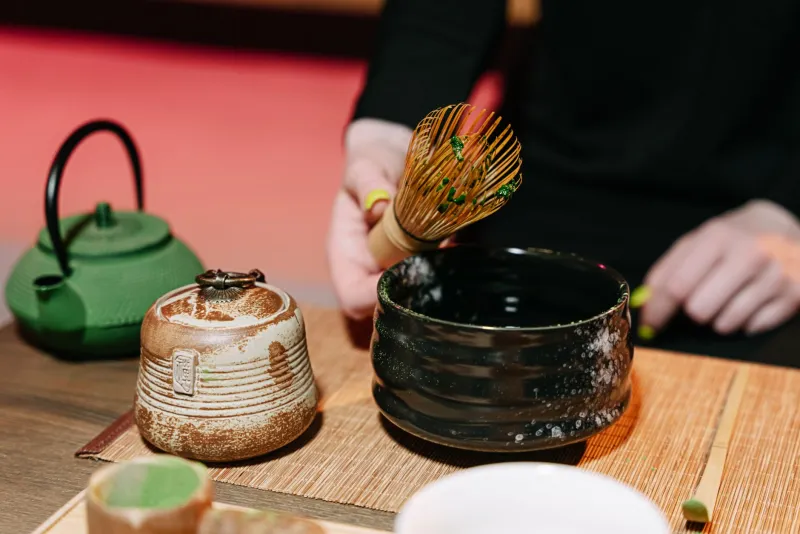
Then comes the final gesture: matcha. In full kaiseki service, the meal concludes with a bowl of whisked green tea, often accompanied by a small wagashi sweet. The tea is bitter, warm, and quiet. Diners are encouraged to linger over it without conversation competing for attention. The ceremony of preparation — the precise whisking, the rotation of the bowl — signals that the meal is over, and that its ending deserves the same care as its beginning.
What American Menus Get Wrong About Endings
American fine dining inherited its structure largely from French tradition, where the meal builds toward the entrée and then pivots to dessert as a celebratory peak. That structure produces genuine pleasures, but it also produces a particular kind of fatigue. By the time a nine-course tasting menu reaches its final savory course, diners have often exhausted their attention, their palate, and their capacity for surprise. Dessert then arrives as a jolt — sugar and spectacle layered on top of satiety.
The result can feel like a meal that ends with an exclamation point rather than a period. Diners leave full, but not necessarily settled. There is no moment of stillness in which the evening is allowed to register.
Japanese tradition offers a corrective. The plainness of shokuji is not austerity for its own sake; it is an act of respect for the diner's state. By the final course, the guest has experienced enough. The kitchen's job is no longer to stimulate but to conclude.
The Quiet Countermovement on American Menus
Across the United States, a growing number of chefs are absorbing this lesson. In Japanese tasting counters from New York to Los Angeles, the shokuji course and closing matcha have long been standard practice. What is new is their appearance in non-Japanese kitchens.
Chefs at tasting-menu-driven restaurants in cities like Chicago, Portland, and Washington, D.C. have begun ending meals with intentionally quiet gestures: a small bowl of congee or rice porridge in place of a second dessert, house-made pickles served with the check, or a simple tea service that replaces the espresso-and-petit-fours ritual. Some menus now close with a savory rice course — seasoned with dashi, topped with a single garnish — that reads, to American diners, as a revelation precisely because it refuses to impress.
The effect on the dining room is noticeable. Servers report that guests linger differently over a final tea than over a slice of cake. The volume of the room drops. The meal acquires an ending rather than a termination — a distinction that diners feel even if they cannot name it.
What Is Lost When the Meal Ends Loud
There is a defensible argument for the loud American ending. Dessert is joy, and joy is not a flaw. But when every meal ends at maximum volume, something is sacrificed: the opportunity for reflection. A meal that ends on sugar gives the diner a final impression of sweetness. A meal that ends on plain rice, pickles, and tea gives the diner a final impression of the meal itself — a moment in which the evening's flavors are allowed to reassemble into memory.
This is not a call for every American restaurant to abandon dessert. It is, however, a case for taking endings as seriously as beginnings. Japanese cuisine's closing ritual exists because generations of cooks understood a truth that modern menus often forget: how a meal ends determines how it is remembered.
The next time a tasting menu concludes with a bowl of rice and a cup of tea rather than a tower of chocolate, resist the urge to feel shortchanged. Consider that you are being offered something rarer than one more indulgence — a moment of genuine closure, whisked by hand, served warm.