Steel With a Soul: What Japanese Knife Craftsmanship Teaches American Home Cooks About Cooking Honestly
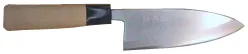
Photo: The original uploader was Ctdunstan at English Wikipedia., CC BY-SA 3.0, via Wikimedia Commons
There is a moment, familiar to anyone who has spent time in a serious Japanese kitchen, when a knife passes through a piece of fish so cleanly that the act feels less like cutting and more like a quiet decision. No drag, no resistance, no torn cell walls releasing unwanted moisture. The ingredient simply yields. That moment is not accidental. It is the product of centuries of metallurgical discipline, and it is increasingly available to American home cooks willing to look past the crowded knife blocks of their local kitchenware store.
Japanese knife-making — known broadly as hamono — traces its lineage to the same sword-forging traditions that defined Japanese martial culture for more than a millennium. When Japan's feudal era closed in the late nineteenth century, the master bladesmiths of cities like Sakai and Seki redirected their craft toward the kitchen. What resulted was not a compromise but an elevation: tools designed with the same reverence for function, material, and form that had once gone into weapons of war.
Understanding why this matters to a cook in Chicago or Portland or Houston begins with understanding what a Japanese knife actually is — and what it is not.
The Geometry of Sharpness
Most Western knives are ground symmetrically, with a bevel on both sides of the blade. Japanese knives, particularly traditional single-bevel styles, are ground asymmetrically — sometimes with all of the cutting angle on one face of the blade. This geometry produces an edge of extraordinary acuity, capable of achieving angles between eight and fifteen degrees, compared to the twenty to twenty-five degrees common in European designs.
The practical consequence is not merely that the knife is sharper. It is that the knife interacts with food differently. A sharper, narrower edge severs rather than compresses, preserving the structural integrity of whatever is being cut. A tomato sliced with a well-maintained Japanese blade retains its juice inside the flesh rather than weeping onto the board. A piece of sashimi-grade tuna cut with a yanagiba — the long, single-bevel slicing knife used in sushi preparation — maintains a clean cellular surface that reflects light and holds its texture when plated.
For American home cooks accustomed to applying pressure through a dull blade, this is a genuinely revelatory experience. The knife does not demand force. It rewards attention.
Three Blades Worth Knowing
Navigating the Japanese knife market can feel overwhelming, particularly for those encountering terms like deba, nakiri, and usuba for the first time. A brief orientation helps considerably.
The deba is a thick, heavy single-bevel knife designed for breaking down whole fish and poultry. Its spine provides the weight needed to pass through bone and cartilage, while its edge remains fine enough for filleting. For American cooks who purchase whole fish from a fishmonger or farmers' market vendor, a mid-sized deba — typically between six and eight inches — is a transformative investment.
The yanagiba, sometimes called a shobu knife, is the long, slender blade associated with sashimi and sushi preparation. Its length allows a single drawing cut through fish without back-and-forth sawing motion, which would damage the flesh. Even for cooks who do not prepare traditional Japanese dishes, a yanagiba performs beautifully on smoked salmon, cured meats, and any application requiring thin, precise slicing.
The nakiri is a double-bevel vegetable knife with a straight edge and a blunt tip. Its flat profile makes full contact with the cutting board across the entire length of the blade, allowing clean, efficient work through dense root vegetables, leafy greens, and herbs. For American cooks who prepare plant-forward meals — a growing demographic — the nakiri is arguably the most immediately useful entry point into Japanese bladecraft.
The Craftsmen Behind the Steel
The reputation of specific production regions matters when selecting a Japanese knife. Sakai, in Osaka Prefecture, has produced blades for more than six hundred years and remains the source of many of Japan's finest single-bevel kitchen knives. The city's craftsmen typically divide labor among specialists: a blacksmith forges the blade, a sharpener grinds the edge, and a handle-maker completes the tool. This division, far from fragmenting quality, reflects a deep respect for specialization that produces consistently exceptional results.
Echizen, in Fukui Prefecture, and Seki, in Gifu Prefecture, are equally significant production centers, each with distinct metallurgical traditions. Seki, in particular, has adapted well to modern manufacturing techniques while maintaining high standards — making it a reliable source for mid-range Japanese knives that offer genuine quality without the price point of fully handcrafted artisan work.
For American buyers, several domestic importers and specialty retailers — including Chicago's Korin-affiliated stockists, and online retailers such as Korin and Chubo Knives — provide access to authenticated Japanese blades with appropriate guidance on selection.
Buying Honestly and Maintaining Faithfully
A common misconception holds that Japanese knives require an extravagant budget. While the finest handcrafted examples can command several hundred dollars, excellent entry-level options exist in the seventy-five to one-hundred-fifty-dollar range. Brands such as Tojiro and Mac offer well-made knives at accessible price points that outperform the vast majority of Western alternatives at comparable costs.
The more significant investment is not financial but behavioral. Japanese knives — particularly those made from harder, high-carbon steel — require different care than their Western counterparts. They should not be cleaned in a dishwasher. They should not be used on glass or ceramic cutting boards, which will destroy the edge. They benefit from regular maintenance with a whetstone rather than a honing rod, and they should be dried immediately after use to prevent oxidation.
This maintenance ritual, which many American cooks initially find burdensome, tends to become something else over time: a form of attention. Caring for a well-made knife develops an awareness of its condition, its balance, its behavior. That awareness extends naturally to the cutting board, and from there to the ingredient itself.
An Investment in Intention
At Daikoku Ginza, we have long believed that authentic Japanese cuisine is inseparable from the tools and philosophies that produce it. The knife is not peripheral to that tradition. It is, in many respects, its most intimate expression — the point at which the cook's hand meets the ingredient, and where the outcome of a dish is already being decided.
For American home cooks, acquiring a quality Japanese knife is not an act of culinary tourism. It is a commitment to cooking more honestly: with greater precision, greater respect for ingredients, and greater awareness of what each motion at the cutting board actually accomplishes. The blade, in this sense, does not merely cut. It teaches.