The Cutlet and the Roux: What Katsu Curry Asks of an American Kitchen
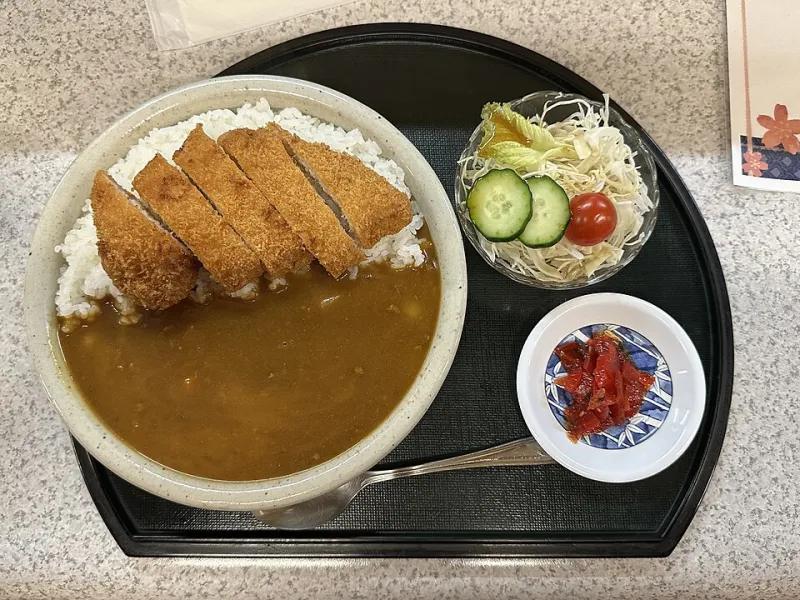
Photo: ノボホショコロトソ, CC BY 4.0, via Wikimedia Commons
The plate arrives with a certain theatricality: a breaded cutlet fanned over a mound of rice, a dark roux pooling at the edges, a few pickles brightening the corner. It is one of the most satisfying things a kitchen can send to a table, and one of the easiest to send out badly. Katsu curry has been rediscovered by American restaurants at least three times in two decades — in food courts, in Hawaiian plate-lunch counters, on izakaya menus — and each time it has been treated as a curiosity rather than a discipline. The case for treating it as a discipline is straightforward.
A Dish Assembled From Three Traditions
Curry came to Japan in the late nineteenth century by way of Britain, not India, and arrived as a Western dish in a Westernizing era. Early Japanese cookbooks listed it under Western cooking; the navy adopted it because rice, meat, and vegetables in one bowl could be served quickly to hundreds of men and, in the era's medical thinking, helped against beriberi. The Friday curry habit that persists in the Japanese maritime service descends from that decision.
Tonkatsu emerged separately, credited to a Tokyo restaurant at the turn of the twentieth century that served a breaded pork cutlet with rice and cabbage — a Japanese reading of European frying. The combination of the two, cutlet laid over curried rice, appears in Japanese dining rooms in the decades before the war and became a fixture of home cooking and school lunch afterward, as curry powder and then instant roux blocks reached ordinary kitchens.
Why It Never Left Japan
The dish answers three questions at once. It is cheap. It is fast. It is unreasonably good. A single fryer and one large pot of sauce will carry an entire lunch service, and the components can be made in advance without collapsing. In the United States, the same economics apply, which is why the dish keeps appearing — and why it keeps being underbuilt, as though a shortcut menu item deserved shortcut cooking.
Where Care Goes Missing
The panko. Most American kitchens buy fine, dry, uniform crumbs and press them hard into the cutlet. Japanese kitchens prefer nama panko, fresh coarse crumbs with irregular, airy structure and a little retained moisture. They fry into a shaggy, crisp shell that stays crisp. If fresh panko is unavailable, a coarse dry crumb pulsed lightly with a splash of water and rested for a minute will move in the right direction. Do not compact it.
The oil. A tonkatsu wants 170 to 175 degrees Celsius, roughly 340 to 350 Fahrenheit, for three to four minutes depending on thickness. Too hot and the crust darkens before the pork is done; too cool and the breading drinks oil. Rest the cutlet on a rack, never on paper on a plate, and slice it only after a two-minute rest.
The roux. This is where a plate is won. Cook butter and flour to a blond stage, add curry powder and toast it in the fat until fragrant, then loosen with stock — chicken, pork, or a light dashi — and simmer for twenty minutes so the flour taste disappears. Finish with a little soy, a spoon of tonkatsu sauce, grated apple, and honey. Let it rest overnight if possible. At service, thin it with dashi rather than water; it should coat a spoon but still flow across the rice.
Rice Is Not a Side Dish
Short-grain rice, rinsed until the water runs nearly clear, soaked half an hour, cooked and then held warm rather than hot. A chilled or over-dense mound ruins the balance of the plate, because the sauce is calibrated to rice rather than to meat. Warm the bowl. A slightly generous ratio — roughly two parts rice to one part sauce by volume — is the usual target, with the cutlet laid across rather than buried.
Building the Plate
Work in this order: rice, sauce, cutlet, garnish. Pool the roux at one side rather than flooding the crust, so the guest controls the moment the breading softens. Add fukujinzuke — the pickled red daikon that cuts the fat — and a few rakkyo, plus a small mound of shredded cabbage with sesame dressing. A 150-gram cutlet, 200 grams of rice, and 120 milliliters of sauce is a portion that satisfies at lunch and does not defeat at dinner.
The Case for Permanence
The dish survives because it is honest about what it is: a fry, a sauce, and a bowl of rice. It serves guests who do not eat sushi, children, and the delivery driver who will carry it six blocks without catastrophe. A tofu or eggplant katsu satisfies vegetarian guests with the same roux. The cost per plate is modest and the fryer is already running.
What it asks in return is not innovation but attention — fresh crumbs, a thermometer, and a pot of sauce that was allowed to simmer and then allowed to wait. That is not a novelty. That is a kitchen doing its work.