Rolled, Not Scrambled: The Deceptive Art of Tamagoyaki and One American Cook's Humbling Education
Ask a sushi chef in Ginza which skill took the longest to master, and the answer is rarely the fish. It is not the knife work, not the rice seasoning, not the delicate art of slicing tuna against the grain. It is the egg.
Tamagoyaki — the rolled omelet that appears as a glossy golden log atop nigiri sushi, tucked into bento boxes, and served in the morning as part of a traditional washoku breakfast — occupies a strange position in Japanese cooking. Its ingredient list is nearly nonexistent: eggs, sugar, salt, sometimes a splash of dashi. Its technique, however, is considered so demanding that in traditional kitchens, an apprentice may spend years on other tasks before being allowed near the rectangular pan.
There is a famous saying among sushi professionals that a customer can judge a restaurant by two things: the rice and the tamagoyaki. Both reveal whether the chef has put in the hours.
Thirty Days of Broken Omelets
To understand why, we followed Sarah Whitfield, a home cook from Columbus, Ohio, through a month-long attempt to learn the dish. Whitfield, who describes her cooking as "competently Midwestern — roasts, casseroles, a decent chili," first encountered tamagoyaki at a counter-style sushi bar in Chicago and assumed it would translate easily to her own kitchen.
"I make omelets all the time," she says. "I thought, how hard can folding be?"
Her first attempt answered the question immediately. The egg tore. The second attempt stuck. The third burned at the edges while the center remained raw. By the end of week one, she had gone through nearly five dozen eggs and produced something she describes as "a scrambled ball wearing a hat."
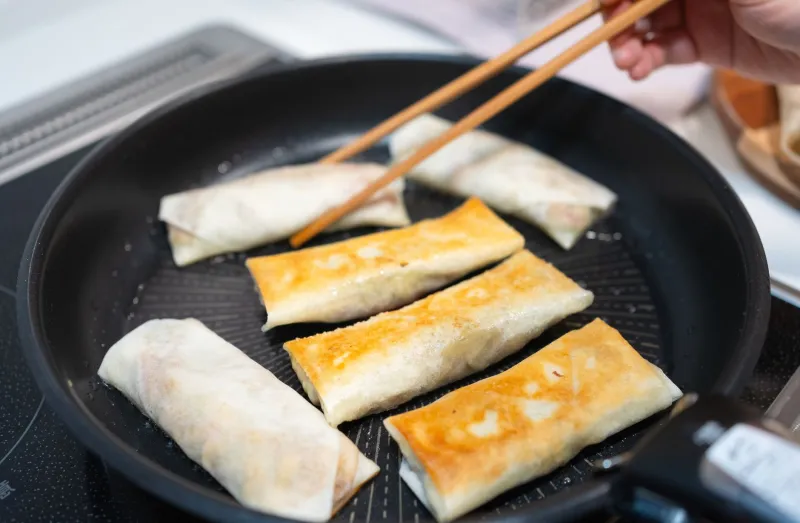
The problem, it turns out, is structural. Tamagoyaki is not one omelet folded in half. It is a stack of four to six paper-thin layers, each cooked individually, each rolled onto the last while still soft, building a dense, tender cylinder through repetition. Every layer must be cooked at precisely the right heat — hot enough to set in seconds, cool enough not to brown or toughen. The timing window is measured in breaths.
"In Japan they call the ideal texture 'toro-toro,'" says Kenji Nakamura, a chef instructor in Los Angeles who teaches Japanese technique classes to American students. "The inside should be almost custardy, barely set, while the outside stays smooth and slightly sweet. Getting both at once is the entire challenge. Too much heat and you lose the custard. Too little and the layers slide apart."
The Pan Matters More Than You Think
Whitfield's breakthrough came not from technique but from equipment. Traditional tamagoyaki is made in a makiyakinabe — a rectangular aluminum or copper pan, typically five by seven inches, that allows the egg to pool into an even thin layer across the full surface. Her ten-inch nonstick skillet, designed for American-style omelets, forced the egg into a thick, uneven puddle that could never set in time.
A dedicated rectangular pan, available online for as little as twenty dollars, changed the geometry of the problem overnight. "It was like switching from a hockey puck to a hockey rink," she says. "Suddenly the egg did what the recipes said it would."
Nakamura recommends a few additional adjustments for American kitchens. Cook over medium-low heat rather than the aggressive flame many home cooks default to. Keep a bowl of batter mixed in one continuous batch rather than dividing the eggs into separate pours, which ensures uniform color and seasoning across layers. And oil the pan lightly with a folded paper towel between layers — a technique borrowed from Japanese home cooks — rather than pouring oil directly, which causes spattering and uneven browning.
A Weeknight Version That Forgives
For readers unwilling to spend thirty days and several dozen eggs on the pursuit, there is a gentler entry point. Nakamura suggests a two-layer version: pour half the batter, roll loosely, push to one side, pour the rest, and finish the roll. It will not win any competitions in Tokyo, but it delivers the sweet-savory flavor and tender texture in under ten minutes, making it a legitimate weeknight side dish alongside rice and miso soup.
The seasoning can also flex to American palates. The classic combination of sugar and soy sauce produces a gently sweet, savory profile; a small amount of dashi powder dissolved into the eggs deepens the umami considerably. Whitfield eventually began adding a teaspoon of the dashi to her batter and describes the result as "the first time I understood what egg could taste like."
Why Bother
Whitfield's final tamagoyaki, on day twenty-eight, was not perfect. One edge browned. The roll was slightly lopsided. She photographed it anyway and sent it to Nakamura, who replied with a single word: "Good."
"That word meant more than any compliment I've gotten on a fancy dinner," she says.
There is a broader lesson in her experiment, one that resonates far beyond the rectangular pan. Tamagoyaki embodies a philosophy at the heart of washoku, Japan's UNESCO-recognized culinary tradition: that simplicity is not the absence of skill but its highest expression. A dish with three ingredients leaves nowhere to hide. Every degree of heat, every second of timing, every fold is visible on the plate.
American cooking culture often prizes novelty — new ingredients, new gadgets, new techniques stacked on techniques. Tamagoyaki proposes the opposite challenge. Master one humble thing, completely, and you will learn more than a hundred recipes can teach.
The pan costs twenty dollars. The eggs cost a few more. The patience is free, though it will not feel that way during week one. Crack them anyway.